Friday, August 24, 2012

Low Parkamoor: Artist's Retreat

This summer 6 of the AirSpace studio residents went off to Low Parkamoor: a cottage in the hills above Lake Coniston, managed by Grizedale Arts.
The cottage has no electricity and a well for water, as well as a composting toilet and some of the rooms have been designed by artists. All water heating and cooking has to be done on an ancient range. It is off-grid living.
I decided that while there I would practise the art of Japanese flower arranging - an interest that I picked up during my residency in Japan. It is something that I have always had an interest in from afar, but never had the time to properly consider. It was only seeing a demonstration while in Osaka, that got me thinking about the idea of 'site-specific' flower arranging.
I decided that each day I would do an arrangement, and aim to create one for each room. One of the things I like about Ikebana is that it is important to select the site for the arrangement before selecting the vessel or the flowers.
The first one I made was for the work room. I selected the rowan berries to compliment the yellow of the cupboard, and used a can that was leftover from lunch. I also chose to put the rowan with some Scots pine, as they were growing next to each other, and I have noticed that selecting plants which grow together seems to work well.
The next day I decided to do an omission variation. I was focusing on what is known as Keishin Ikebana - which has 3 main lines Shin the biggest, representing heaven, soe, which is 75% the length of Shin and represents man, and hikae, which is 50% of shin and represents earth. In the omission variation Soe is left out, and is therefore a display of modesty. I used a shallow bowl, and hid the kenzan (spikey thing which makes the flowers and plant stems stand up) using pieces of slate. 
Next I created this one, which used some wooden ornaments from the house, and this one is a split variation, where there are two vases - with a pool of thought space in the middle.
I made the split one for the window sill overlooking where Kate Lynch was building a den outside - an escape space for quiet time.
I went on to make one for each of the bedrooms, this one called 'The Kill' was made to go with the tiles in the middle room.
One for the end room, where I matched up the colours of the chamber pot to the flowers selected, and one for the room I was staying in.
The room  I was in had delicate blue shutters, but the main thing I was responding to was the view of the fir tree moving against the sky, which I could see from the bed in the mornings.
The feeling of lightness, and movement was what I was trying to pin down, and also - from the window I could see harebells blowing in the grass.
One of the days it poured with rain, which made it quite difficult to collect flowers, but I rushed out during a break in the rain to collect some rowan and fir cones, and decided to create a mobile ikebana. Ikebana is all about balance, and this one was even more challenging. The last one was made for the kitchen.

Sunday, August 19, 2012

CAMouflage: Salzburg

A documentary photograph from my Chambermaid Performance, from the Platform P event in Plymouth last November is currently on display in the CAMouflage exhibition, curated by Antonio Manfredi at Stadt Galerie, Salzburg.
As part of Antonio's continuing CAM ART WAR, his current activity involves exhibitions which show artists work on low quality, photocopies, which will not survive past the exhibition.
Helga Gasser (an artist from Salzburg, who has been helping Antonio with the show - and who I met on the Harlech Residency) sent me some documentary images of the install and events. I am really pleased that documentation from a performance has been exhibited in this way - as I have never shown documentation before. It demonstrates how important good documentation is, I am lucky that I have a good documenter, that I can trust to get the shots I need, in Glen Stoker, he took this image, and has documented many of my events and performances over the years.

Monday, August 6, 2012

Japan residency, drawing to a close

My residency in the mountains ends the day after tomorrow. I will have been in Japan about 3 weeks by the time I leave and I think it has been a great visit. I have made some fantastic connections to build on for the Indefinable City project, I have found out quite a bit about practising as an artist in Japan, I have had a chance to reflect on and evaluate my practise over the past few years, and I have learnt to make gyoza.
In the U.K. we are talking a lot about cuts to the arts, and what impact that might have on arts activity. In Japan everyone I have spoken to has said that there is not a lot of funding available here, and what there is, is so difficult to get hold of, that most people don't bother - I have heard more than once: 'the energy put into applying could be spent on making more work.' I have also heard that being an artist here is hard - everyone that I have asked has an extra job, and also stark differences in how artists and art activity is viewed have surprised me. Jamie told me that most people regard art as something that you do as a hobby, and like most hobbies in Japan - this hobby is expensive. Jamie took me to Tokyu Hands in Osaka - a department store which seems to be dedicated to hobbies - it seemed that there was a kit or a tool for everything there (one which stood out was a kit for making a kaleidoscope). So, artists wishing to show their work can not only expect not to be given a fee from the gallery, but on the whole will be asked to pay a hire fee themselves for the space - something which is often obstructively expensive. This might be OK if the art market is strong, and the artists can expect to make money back on sales, but a few people told me that it is relatively difficult to sell work - one person told me this is because on the whole, people do not have a lot of space for showing work in their homes, so don't buy it. I recall going to the Tokyo: DesignFesta when I was in Japan in 2003. It shocked me that there was such a lot of talent in this enormous warehouse thing - and how cheaply people sold their work and skills - I had a small (A6) portrait sketched by a lovely artist called YUMI, it cost me 100 yen which was 50p at the time. DesignFesta also run a gallery in Harajuku, where artists can hire space for the day - current price is from 525 yen (about £5 in today's money) for one piece - and walls are split up like the image below - so there is no telling what your work will be exhibited with.
This was really interesting - I advocate a policy of (almost) never paying to apply for an opportunity or to show my work - so how would I get on in Japan, where I would be expected to pay someone else for the privilege of showing? Also, a lot of my work would not fit in one of those spaces (being performance, intervention etc) and most of it is unsaleable, so the situation for artists like me would be quite difficult. In fact, I didn't meet many artists who are like me while in Japan, and when showing people my work, or talking about it I was told, no, we don't have work like this here.
I met a very interesting artist, Keijiro Suzuki at an opening at Galaxy Gallery in Osaka on Friday night. I felt that of all the artists, his ethos and approach to practice was most akin to mine, so no surprises that he didn't study in Japan. We had a long talk and it is even harder for an artist to practice here if there work is like his. He creates situations as art practice.
While I have been here I have been trying to write a descriptive text as an introduction to Indefinable City II - the idea being to write about and plan a city. I had thought about the city being designed by artists, and that urban planning - if designed by artists, would be much more effective and better. I have begun to plan a city: called Mountain Island City probably inspired by the amazing community feeling here on the mountain.The idea has developed that this was a previously undiscovered island, and that 50 years ago at a world summit it was agreed that the new island would become a testbed for a new way of living, embracing all things sustainable and ecological - and populated by artists and other creative people. I started writing, but it got me thinking - would this be the worst place to live? All these egos on one island - and maybe we would end up being uninspired - having nothing to rub up against? That will have to be something to come back to.
Also, on my second day here I happened across an ikebana demonstration in Takashimaya, Osaka. I was struck by how beautiful the displays were, but in particular the arrangements which surprised me, were the ones using more natural looking plants (weeds), of which there were only a few. It got me thinking about the story that Michael told me. We were at work, but we had gone onto the street, because the Olympic Torch was due in the city that day, and to celebrate a parade was planned, so we went out at lunch time to have a look. The parade passed, and we noticed a man who didn't look quite right, moving along the street with the other parade goers. He looked quite drunk, and was wrapped in a tattered looking St. George Flag. Michael told me that he saw him a few days later again, but this time by the site of the old ABC Cinema, next to the gallery - the site that we have been looking at and making work about for some time.
Since TESCO was built, and the land there turned over, an amazing array of flowers have appeared in just over a year, the man was foraging about on the site, and when he emerged from the other side, Michael was amazed to see that he had collected the most beautiful bouquet, wrapped in newspaper.
This got me thinking about an ikebana class on the ABC site. I have bought a couple of great books on Ikebana for reference, and though they are in Japanese, they are very useful. One of the things I like about Ikebana is that it celebrates all forms and states of nature, so as much as the new bud is cherished and presented, so is the old dead form, with moss growing over it. I would love to do a wild ikebana class, using found and salvaged 'vessels' instead of fancy vases, as I think that this really represents the other aspect of Japan that I really like (as described by Yoshida Koh in a previous post - all about how objects are being more cherished and rubbish recognised as potential resources since the earthquake. So, for our studio show in September, I plan to explore using Ikebana on the ABC site, and perhaps do a workshop there. (Below and above: Aiko and I collecting plants and flowers from the mountain to do some ikebana training.)
Of all the residencies I have done, this one has seen me do the least in terms of making new work, and the most in terms of reflection and thinking. Also, I feel I have seen a lot of new things, and learnt about a different context for how artists survive. When I get back, I know that there is so much to do at AirSpace with Conjunction coming up in October, plus I start my new job as joint course leader of the BA Fine Art at Staffordshire University - so I think maybe what I needed was space to get my head round all that, and a break from the rollercoaster of practice, job and gallery that has been the past 5 years. Thanks to Jamie and Aiko for providing this amazing retreat space. I get the feeling that a residency at Headspace is whatever you need it to be. There is an enormous studio room, a small two storey gallery space, lots of outdoor space, and a whole mountain to explore (and that's just in the immediate vicinity.) I recommend this residency to anyone. Click here for details of how to apply. There is funding available from Anglo-Daiwa, and the new arts council international funding stream looks promising, if you are also making international connections alongside the residency. Jamie can put people in touch with Osaka based galleries that could lead to an exhibition: for example Galaxy Gallery, Soho Gallery and Tsukiyo to Syonen (I met the Directors from each and they are great - and all of these spaces will hire their gallery out.)

Thursday, August 2, 2012

PIGDOGANDMONKEYFESTOS 2

Shaun Doyle and Mally Mallinson invited me to contribute a manifesto for the second edition of their newspaper/curated paper artwork 'Pigdogandmonkeyfesto.' The first edition was launched from Banner Repeater, London a while back and had some great artists in it, so I was really pleased to be asked.
The newspaper will be a collection of 24 manifestos by artists, and the brief was like this: PIGDOGANDMONKEYFESTOS
"Racing around a fireball is a blob of filth on which ladies stockings are sold and Gauguins prized, truly a most deplorable business..." Walter Serner 1918


PIGDOGANDMONKEYFESTOS has been conceived as a collection of contemporary artists manifestos. Celebrating the stupidity of declaring your intentions to the world with the hope of changing it, PIGDOGANDMONKEYFESTOS will be a tragi-comedy of baroque minimalist clownery, grandiose and ill conceived in extreme.


Like an over stuffed letterbox at election time, PIGDOGANDMONKEYFESTOS embraces all the half-baked ideas, dead ends and prejudiced rants that make artists' manifestos wondrous artworks in thenselves. Accepting the paucity of the written word, images made in the spirit of the manifesto will also be included in this landfill of a publication.


24 artists are each to be given a single page.'
I didn't have time to do the manifesto before I came to Japan, but thought I would do it here. I had a few ideas: one was to use the images from the Modes of  Practice Manifesto workshop we did to make a 'how to manifest' manual sheet (this would have been quite a straight take on the theme) the second was to take the first 10 manifestos to appear on google images, and take one point from each - so the first point from the first, second point from the second etc. If I had have done that I would have ended up with this:
Then on the first night at Headspace, Okata-San the local farmer came around and demonstrated how to use leftover rice bran (the brown bit on rice) to improve the nutritional value of cucumbers. There seems to be an unwritten manifesto on the mountain, where villagers all share resources: every day more cucumbers arrive, or someone brings aubergines, and Jamie and Aiko help Okata-San at harvest time, and he then provides them with rice for the rest of the year. Land and space is also shared, exchanges taking place are natural. Another villager arrived the other night with a ladder - saying he noticed that Jamie and Aiko were not picking their plums, (they don't have a long enough ladder) so he offered to pick them, in exchange for a share of them. They can be used to make plum sho-chu. So, this mountain village is all about recognising and sharing resources, helping each other out, supporting each other - a bit like some of the things we agreed in the 'Modes of Practice' manifesto workshop.
I decided to use the photos of the cucumber treatment for my manifesto manual, and I am quite pleased that something made in the mountains of Nara, Japan, will be distributed around London. I am looking forward to seeing the finished publication.

Tuesday, July 31, 2012

Reflection time at Headspace

I have been at Headspace for a week already. I feel like I haven't physically done as much as I would usually do on a residency, but this residency is intentionally different.
This is a retreat as much as it is a residency, and what I quickly realised was that I have very much needed some Headspace! Over the past 5 years my art practice has been a roller coaster - moving from one thing to another, often having a number of projects on the go at once. I speak all the time to students about the importance of documentation, a written commentary, and time to reflect. I have been steadfastly doing the first two, but time to reflect has been a luxury that I could not afford.
So this week, alongside some drawing,walking, photographing, and thinking about 'Indefinable City II' I have also been looking back at my C.V. and blog, and categorising the projects and activities, to see if my work is as coherent as I thought. The categories that I set out as important are: work about regeneration, advocacy of art and artists, green stuff and things that don't fit anywhere: I found that some things do not fit into the categories that I set out, and some things fit into more than one. I then went through again to see if I could draw out any common themes that seemed to emerge, these were; regeneration, sustainability, walking, green/growing, interim use for derelict/unused sites, conversation/communication and then some woolly ones: something to do with text, often suggesting the potentially romantic, something to do with recognising whats around in terms of resources or how space is organised and used. 
I then went through my c.v. and took off everything that I didn't consider to be 'good art' or something which actually moved me on and was authentic enquiry - that felt good. From what was left I was surprised to find that 14 out of 18 projects were to do with regeneration or development, but they are also often to do with the artist's role in a changing society/city/landscape/economy.  Going through the same list to see which involve conversation - the number is 12, so there are some very strong threads through what I do. This seems to suggest that though I am really bored of the word regeneration, I am still interested in it, but perhaps even more now to do with 'The artist's role in (a) changing society.' I have also been thinking about the way many of the works respond to gaps or situations where a solution is being sought - I have written up my thoughts on this as a piece of text looking at Participation. Also, I do seem to like creating conversation spaces: despite this being something that actually makes me nervous. 


I have also tried to draw out what I am still interested in exploring, what do I get some (artistic) satisfaction out of and wish to continue with or do more of, what should my focus be for the next few years?: 

  • Text drawings - because they are something I can do in the studio for a long period of time, and they give me time to think (each one takes 10 hours). 
  • Work: what does art work look like? This comes from sometimes being misunderstood, see text on participation below. If I am cleaning a hotel as part of my work, does that make me a cleaner or an artist?
  • Printing techniques: I really want to learn letterpress properly and do some posters and books.
  • Adoption of derelict sites: perhaps adopt the ABC site for a year and do different events and activities there. Interested here in interim activity - what happens in between demolition and development. Also, associated here is the idea of mobile activity - work which can be moved about.
  • Small Change: idea of recognising resources and making something with them.
Here is the text I have written around my thoughts on gaps and participation:
My work often involves participation, but not always for altruistic reasons. Yes, I am interested in working with others, in creating situations and activities for people to get involved in, but not necessarily because I want them to get something out of it (although it very good if they do, that is not my prime concern.) Often, it's because I want to see their response; like an experiment.
Also, sometimes my work has been called 'socially engaged' which sounds nice, but more accurately, I think my responses are often a response to a gap, or a lack (I think Adam Chodzko refers to them as interruptions.) I hope to frame or draw attention to the gap - sometimes by filling it (temporarily) sometimes by creating a space exploring it and having a conversation about it. This feels like an important part of what I do. I am not a problem solver, social worker or box ticker.
The question about value does not overly concern me - I believe that the experience of the artwork, new context, life experience is enough of a reward in itself but still: the question about value seems to arise more, with work of a participatory nature than with other art practices: but how to measure 'meaningful value?' Can't it just be 'I enjoyed being involved, seeing, doing that?' Paintings don't have this problem.
I am interested in where the artwork is with works of a participatory nature - does there have to be a definable moment (event, performance etc) or object (solid artwork, book, exhibition etc) Or can the entire project be the work. Is it enough that an interaction has taken place? Is it enough that I, as instigator artist have designated this interaction as an artwork?
A man came by the window just now and I waved at him - If I had said beforehand that if someone comes by, and I wave at them, and that will be the artwork - then could that be participatory art?
My work is often about suggestions or propositions for how to fill the gap, but the proposition is time limited, because ultimately I am not a gap filler (in a permanent sense) but like the bandstand piece, or the tour guide or the travel brochures in Harlech - the work responds to where something is missing, and someone (me or someone else) expresses a need to fill the gap. My work will temporarily fill it, but not say - this is the answer, but rather, this could be one answer. Then maybe someone will be inspired to take it on, which has happened - but then again, maybe not (which I am also fine with.)
Sometimes, the way that the gap needs to be filled requires me to create an intervention which looks like something else, the viewer (and even other artists) can misconstrue the intention of what I am doing. For example, with the Bandstand piece, from Common Ground 2010, I organised to repopulate the forever empty bandstand by hiring a brass band, putting up hanging baskets and bunting, organising for  chairs to be delivered and giving out ice creams -  people said, this is great, you should organise bands to play in the park all summer.
My interest as an artist was not to be the band stand events organiser, but rather to draw attention to the band stand as a potential event spot. Since then Park Live! happens regularly in the park (which I am not saying is because of my intervention, but it is possible isn't it?) In a different way the travel brochures created as part of the Harlech Biennial residency, May 2012 were misunderstood. I worked with the landlady, Rhian Roberts, from the local pub to create a travel brochure for the town, which has seen a major decline in tourism over the past few years, which isn't helped by a lack of advertising about the town, and what can be done there. We created a brochure together based on Rhian's ideas of what makes Harlech great. I visited the places that she told me should go in the brochure, which helped to orientate me around the town. At the exhibition at the end of the residency I heard some of the other artists from the residency discussing my work, they said - 'She is a graphic designer - she makes brochures.'
I wonder if I should worry that I am not communicating my intentions well enough, or if it is OK when people misunderstand the work.

Friday, July 27, 2012

Tsugihagi

Yesterday I mentioned to Aiko about one of the ideas I had - I like this idea of Boro - using scraps of clothes to patch up rural work wear, and that the workwear has become collector's items. Aiko told me that Boro means a piece of clothing which is in rags, and is not what I mean really, I was trying to explain it is using scraps of something that are not worth anything, but together they become worth a lot. Aiko said this is more like Tsugihagi. I wanted to ask the villagers if each person will give me a piece of scrap rag and I could then stitch them together to become Boro (Tsugihagi), I had mentioned it to Jamie as well and he said - you can't just turn up at people's houses, it's not like at home. I wasn't sure what he meant until today: I wouldn't really turn up at people's houses at home either, but I see that there is a whole set of customs to be observed when visitors call. Aiko said she would help me to collect 'hagire' (which means a strip of material) from the villagers if we see them. 
This morning we went along to Aiko's vegetable patch a few minutes down the mountain. She is growing tomatoes, cucumbers, beetroot and peppers. While we were there Yoko-san, one of the villagers arrived to say good morning, and see what we were picking. 
Aiko introduced me and explained what I am looking for. Yoko said, she doesn't really have any hagire, but that she has some old traditional workwear ( the type that I seemed to be talking about in relation to Boro) and she might be able to bring me something. 
On the way back to Kayamori House we met another villager, Toshiko-san. Aiko asked Toshiko too, and Toshiko said that she had been a seamstress, and so had plenty of strips of material if we needed them.
When we got back to the house I did some drawing, and then after not very long Toshiko-san arrived with a bag full of cucumbers 
(which is funny because every day at least two villagers bring a bag of cucumbers - we are eating a lot of cucumbers - even the cat is eating them) and a bag of hagire. So now I see what Jamie meant, when you visit, you must bring a gift (bag of cucumbers for example) and then the host must make tea and provide cake, so if I turn up at people's houses they may be obliged to feed me, and also I can't speak Japanese, so it would be hard to explain what I was doing there.
Toshiko's bag of hagire yielded a good selection, of which I chose the ones below for my Tsugihagi, so I think I am already getting somewhere with it.
The Boro-wear that I had seen was always dyed indigo - because rural farmwear was usually dyed with indigo pigment, as it is a natural insect repellent - and there are a lot of mosquitoes here. Aiko and I are going to do some research to see if there is anything growing here at Kayamori that we can use to die the Tsugihari. Later on we are going to local rice-farmer Okata-san's house to eat non-eel (eating eel at this time is meant to make you virile - but I am a vegetarian so Okata-san is preparing me non-eel) and we will ask him if he has any hagire for the Tsugihagi. I like the idea of creating this Tsugihagi, because it seems that the community on the mountain is all about sharing - hence the abundance of cucumbers at Kayamori today. The Tsugihagi will be a representation of shared resources.

Wednesday, July 25, 2012

Headspace Residency: Nara Mountains, Japan

I came to Japan around 10 years ago, straight after having gone straight through 20 years of education: GCSE's then A'Levels, then foundation, BA, MA and PGCE. I decided to take a year off and see a bit of the world. It is only the last couple of years that I realised that what I was imagining Japan to be at the time (and which I only got fleeting glimpses of through train windows on the way to the airport,) was rural Japan - and so where I ended up (Tokyo) had not satisfied what I had wanted to explore.
When Ellie Doney, from Manifold (the artist group that AirSpace collaborated with for the BCB last year) sent through a call from Headspace in Nara, I immediately got in touch. The idea of a rural residency/retreat really appealed to me, and so I was delighted to be accepted. Months later, and I am suddenly here.
I had the idea of presenting Stoke-on-Trent as an exotic city to artists here, and doing a workshop where we would look at areas of the city and rebuild them according to Japanese design principles, and with an eye on creative purpose.
Jamie explained to me later that this really is a rural retreat, and that there are not many people here, let alone artists: mainly elderly farmers, and so my idea would not work. In fact, that I should come, soak up the place, and see what happens. So I intend to do that, but still come equipped with a plan to make a 'How To Retreat' Kit, for other artists that come to Kayamori House for the residency after me.
So now, I arrived yesterday - Jamie from Headspace met me at the train station, unfortunately I was late: as I found it difficult to understand how to buy the right ticket for the train! On arrival Jamie took me up to 'the viewing point' to get a sense of where we are.
We are 500m above sea level, and so though it is still very hot, it is cooler than the city. The viewing spot is close to a small shrine with a lake (see top image), full of big koi and turtles.
Then we went to Kayamori House and I had a look around. Wow.
I am not sure at this stage how much to say about all that I am seeing and doing, as this could turn into a travel-log. But perhaps I can summarise in words and pictures.
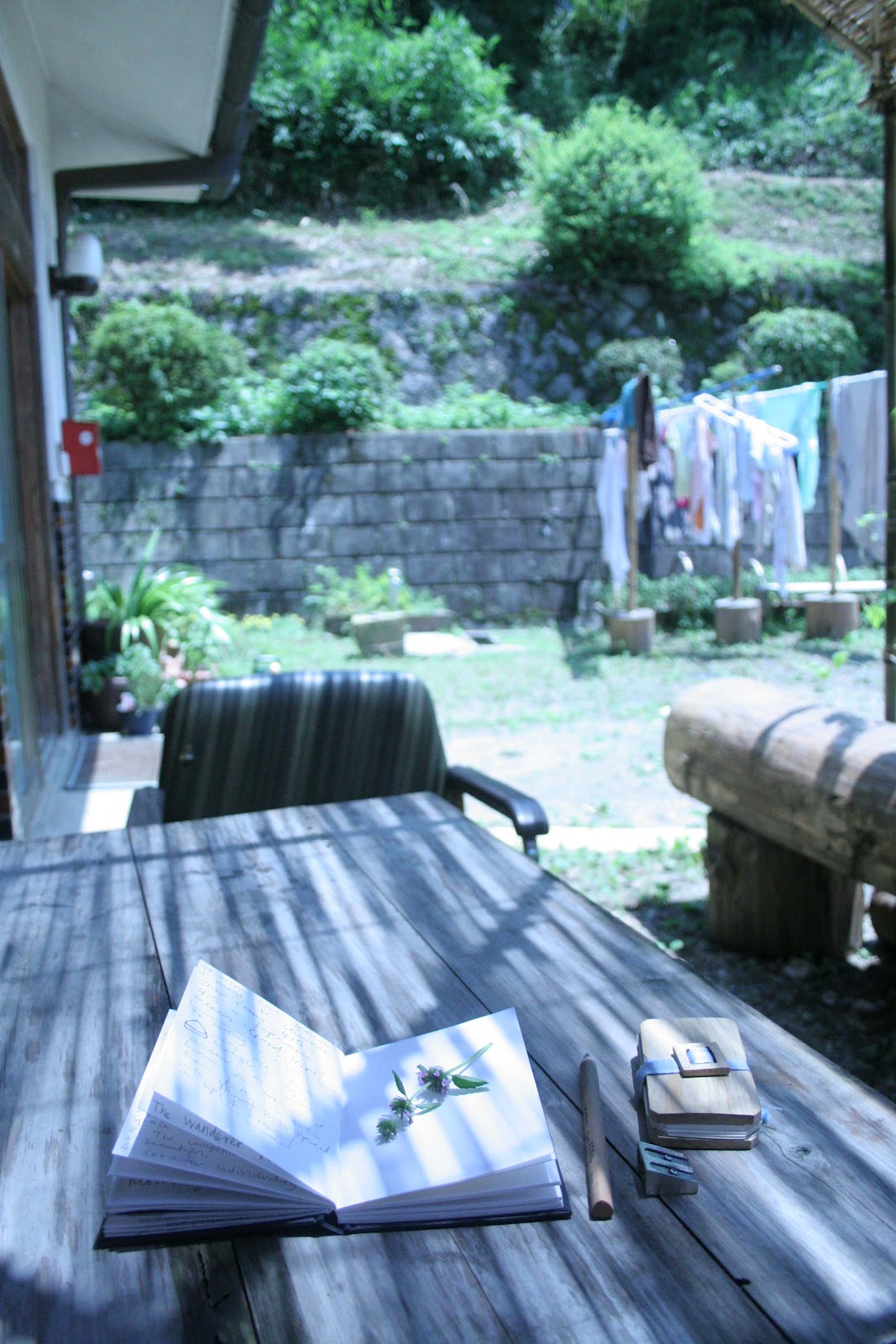
Explored the house and garden (above - my studio space for the next two weeks), met the cats, saw a lot of bugs, looked at mint drying on a rack in the sun, ate some amazing home-grown/home-cooked food made by Aiko,
met Okata-San a local rice farmer, who brought rice bran around and demonstrated how to use it to preserve vegetables, tried 20 year old snake sake made by Okata-San (he caught the snake and made the sake), went to a rice field to look at fireflies, had my palm read by Aiko, collected Cicada casings with Jamie at breakfast, 
saw more bugs, and now thinking about what I am going to do for the next 14 days. Below is an image of the veg bowl here at Kayamori, most is grown here, but some is from neighbours: Aiko got up early this morning to go to meet a local farmer who emailed yesterday to say he would be farming on his land until 7.30 this morning, and to come and pick up some corn on the cob, and also Aiko and Jamie go and help out Okato-San during the rice harvest, and he gives them rice all year round.Sharing. 
Plans formulated before I arrived, in Osaka, and since arriving at Kayamori include:
photographing the bugs to make a mushi print (mushi is bug in Japanese), creating the 'how to retreat' kit, a series of postcards with retreat based wisdom on them, collect sounds (Jamie tells me at the moment the sound of cicadas is just the baby ones - a bit like crickets) but that over the next two weeks the sound will get louder and become the whirring, so it will be interesting to try to record that. I wish I had a better sound recorder - I am just using my phone; also I will select and pick and press a flower each day.
Today's flower is from the sour gourd: which is growing just outside the door. Jamie tells me it is like a lumpy skinned cucumber, and has to be cooked correctly or tastes disgusting. And I hope to explore the idea of a text piece, walking around the imagined city, perhaps it is a mountain city? I want to include an exploration of Boro (which is the repatched and mended rural clothing - so patched that the original garment is almost gone) and I would also like to consider the art of kintsugi: which was from ceramics = where broken pots are mended in gold, and then become more valuable. 
Also, ideas for when I get back: turn the photos and sounds into an animation, and make a full-size wooden doll version of myself - the kind where you pull the strings and the legs and arms kick up - I saw one of these dolls at the Museum of Housing and Living, and it made me want to make one, and the idea of Brownfield site ikebana.
So what do I do first?