Thursday, January 16, 2014

Birder's Paradise: Appetite Commission

Andrew Branscombe and I have embarked upon a new commission. We are thrilled that the ideas we had to develop a project called Birder's Paradise (see previous blog for details of history) has been commissioned by Appetite (part of the Arts Council's Creative, People and Places programme to bring arts to areas where there is less uptake in arts and culture) which sees 3 million in arts funding coming to the city of Stoke-on-Trent, specifically to build audiences in the area. Our commission comes from The Kitchen section of the Appetite programme, supporting artists in the area to research and develop ideas, and providing seed funding for projects.
We sent in an expression of interest to Appetite, as we felt their remit, to create an appetite for the arts in Stoke, through a variety of commissions could fit really well with our ideas for Birder's Paradise, which would bring arts to the public via conversations about Birds and Wildlife to be found locally.
Here is the proposal that we sent in.

Birder's Paradise: Stoke-on-Trent.
A Birder is different from a Twitcher. While Twitchers will travel miles to see an exotic or rare bird type, Birders are much more interested in spending time with the wildlife and creatures that surround them in their daily lives. This is something that we, as artists, feel an affinity with, in relation to Stoke-on-Trent. To give an idea of our possible approach to involvement in the Appetite Programme we propose to create a mobile research lab 'Birder's Paradise' a mobile bird hide, which can travel to open spaces around Stoke-on-Trent and North Staffordshire, to gather data, identify species and deliver activities and events which create a dialogue with residents and users of the sites about wildlife in their local vicinity. The conversations around wildlife are meant as a 'way-in' to talking to the people of the area about where they live, and what makes it special. Unlike some of the other Appetite projects, the appetites we will be discussing will be of the avian variety – and we will be able to talk to people about urban birdlife, what they eat, and how they can be supported.
The content gathered from those conversations will lead to developments within the project and inform the direction of our response. We know, from personal experience, that taking an interest in green spaces and the wildlife there can improve health and wellbeing, and hope to talk to the public in Stoke-on-Trent about how they experience their local environment, and what other ways they may like to engage with it.
Andrew Branscombe: Ingrained 2010
We are Andrew Branscombe and Anna Francis (AirSpace Gallery, Stoke-on-Trent.) In terms of previous relevant experience: we have plenty of experience of managing projects which engage the public, and which lead to developments, we welcome the opportunity to tell you about some of these projects in a meeting. Also, we have recently developed a small Yarden Space at the back of our artist-led gallery into a Bird Haven, where planting and landscaping is all planned to support the diversity of birds and other wildlife in the city centre, which can act as a catalyst and learning space to encourage others to consider our feathered friends in the planning and use of urban spaces. The project was complete in April, 2013 - and we would love to embark on a venture around the area, where we can take our knowledge from the Bird Yarden on the road, and visit other areas of the city, to talk to people about what it is like to live there and the diversity of wildlife in those areas. As practitioners we have an interest in how artists can have an impact on the environment, and urban development.
Anna Francis, Brownfiled Ikebana 2012
A recent project 'Brownfield Ikebana' shows the type of approach we would take to public workshops on the sites where the Birder's Paradise Hide could visit. In 'Brownfield Ikebana,' Anna used traditional Japanese flower arranging techniques as a starting point for workshops and performances, bringing participants to a local Brownfield site. The workshop saw participants using and identifying 'weeds' and litter to create beautiful flower arrangements, but more importantly to discuss these interim sites and their uses and importance.

The Birder's Paradise project would involve a number of stages, some of the content of which is unknown as yet - as our usual working methodology allows space for participants and site to impact on direction, and activity, but to give an idea:

1. Construct the mobile bird hide: The mobile bird hide would be a converted caravan, camouflaged to blend in to Green and Urban Open Spaces, but also referencing traditional bird hides. The bird hide would act as a temporary work space and hub for working on various sites in the area.
2. Research and development stage: This would see the artists making connections in the various locations, meeting stake holders and identifying key people to involve in the project. We would identify specific locations and then visit these areas to undertake research; looking at uses, users and preliminary identification of wildlife types, and planning our next stage/response. 
3. Intensive Discovery Period: We would endeavour to spend time on the sites, holding workshops, collecting data, making art works. These will be planned and designed in relation to the people and sites identified in the research and development stage, and would centre around what it is like to live and work in the areas, and what can be done to involve people more in the arts in these areas. 
4. Presentation: we will allow the process to determine what our final product is, but for example it may be works for an exhibition; venue to be found during residency, or a mobile exhibition in 'The Mobile Bird Hide' returning to the areas previously visited, and presenting a vision of Green Stoke.

We hope that Birder's Paradise will demonstrate that developing an appreciation and knowledge of wildlife and nature is possible in built up areas and that spending time in green spaces can be incredibly important to the health and well being of residents. 
Appreciating and nurturing urban birds is a mutually beneficial activity, for bird and human, and ultimately we hope that the project will start to reframe familiar sites for residents and users, encouraging people to use open green spaces more, and not just the landscaped civic ones. We also hope it will create conversation - leading to content which talks about what life is like in this area, and how citizens can make it better.
Budget items:
Purchase of caravan and renovation
Other materials for workshops and temporary exhibition
Artists Fees: 2 X artists for 10 contact days plus other time spent.

We also sent in images from previous works, and our C.V.'s. 
We were really pleased that our expression of interest began a conversation with the Appetite producers; to explore how the commission could support us as artists in working on a project locally, what we hoped to gain in experience, and how this could be build into the Appetite Kitchen programme of support for artists in the city. The commission was granted, and we are now embarking on the project. They will be announcing a call for Year Two commissions soon, so artists: watch this space.
So far, we have purchased a caravan, and found a site to store it and renovate it - transforming it from domestic holiday home, to urban bird hide.
Andy has ripped out the innards of the caravan, and will be rebuilding in the style of the bird hides that we have seen in our research process. (see Andy's write up here.) 
We are aiming to secure partnerships with 4 sites around the city to take our mobile bid hide in the Spring and Summer - and carry out our research processes, and creation of artworks. Then we will plan and deliver workshops on the sites with the public, or stakeholders. We hope that the sites we choose will be a combination of different types of land: managed green space, for example, the grounds of a stately home or public park, wetland spaces - for example Middleport Lake, a Brownfield Site and an inner city green haven are all possibilities to explore. We will begin the process shortly of finding partners or stakeholders in those areas, and discovering who might be interested in working with us.
One of the things I am hoping to learn about during the project, as well as exploring how the different sites support bird and other wild life - I want specifically to learn about how mosses and lichens can be used to ascertain the pollution and air quality of an area, and look at ways of working with these fascinating plants.
We are really looking forward to working with the Appetite Team to make connections, and are really grateful for the opportunity to see our ideas develop.
We are also pleased that there may be an opportunity within the project to see the artwork commissioned by Capsule for the New Library of Birmingham (see previous post) will be reused in the libraries around Stoke-on-Trent prior to our residencies around the city with the bird hide, as a way of raising awareness of what we are doing, and advertising out workshops and activity.
The Appetite programme is supported using public funding by Arts Council England and led by the New Vic Theatre in partnership with B ArtsBrighter FuturesPartners in Creative Learning and Staffordshire University. Appetite is also supported by Stoke-on-Trent City Council.

Birder's Paradise

In 2013 at AirSpace Gallery we developed the back of the gallery space to become what is now known as the Bird Yarden. We were really interested to think carefully about that outdoor space, as all around the city the many brownfield sites which had developed into interim wildlife havens are now being developed, leaving many birds and animals with less space to forage, nest and roam. Our little outdoor space is then an important part of the local ecology.
We designed the space so that the planting schemes and landscaping all maximise nesting and food sources for birds, as they are our most regular visitors. We have actually been feeding the goldfinches in the yard for around 4 years, and their numbers have grown as a result. The launch of the space was a fantastic success, and is documented here: http://airspacegallery.blogspot.co.uk/2013_06_01_archive.html
More than 100 people came to the gallery that day for the various talks and workshops, and we have a great time.
Myself and my partner Andrew Branscombe felt very positive about the experience. It was around the same time that we went for a walk around the grounds of Calke Abbey - and came across a series of bird watchers and bird hides, which got us thinking...People were very positive about the Bird Yarden, and it felt to us that accessing conversations with the public about the environment and birdlife seemed to happen much more easily than some of the conversations we have had about art. It is also pertinent to consider wildlife in urban environments in relation to regeneration, as many brownfield sites around Stoke-on-Trent are now being developed - and what have become impromptu wildlife havens are diminishing in number. We are interested in exploring whether developers consider local ecologies in relation to development.
This lead to a collaborative idea developing, we started thinking that our learning from the Bird Yarden could be taken out of the gallery, and around the city - visiting different sites, and exploring spaces through a project looking at Urban Birdlife and other wildlife.
We came up with Birder's Paradise.
Birder's Paradise would see us becoming Urban Birder's (Birdwatchers) with a mobile Bird hide lab, which can be taken to different sites, and used as a way of exploring space - and creating artworks and conversation about Regeneration, and the impact that man has on the environment, and the importance of making space for nature within development plans.
We hoped that we could explore potential opportunities for the project - putting together a proposal which involved renovating a caravan, turning it into a bird hide, which would be used as a residency space initially, to research and make works, and then carry out some workshops with the public, and later create an exhibition of our findings to be exhibited within the bird hide and toured around. We went on a research trip to Dungeness RSPB reserve.
We looked out for relevant commissions, and applied to a couple of projects which seemed to fit: but what we really wanted to do, was to carry out this project in Stoke-on-Trent, so we put the idea on the back burner, while we considered how to make it happen.
At that point there was a call for artists to propose works for the exciting New Library of Birmingham. I have always wanted to do a project in a library - and this looked really fantastic. So we thought about how Birder's Paradise could be adapted to a brand new library setting, and put forward a proposal to do a one-week residency at the library, working with the public to carry out 'birdwatching' activity and discovering species of birds that can be found in books, working towards creating a birdwatching trail through the library.
We were lucky enough to be shortlisted and later offered a commission (rather than the residency) to create the birdwatching trail. At first it seemed a bit strange to be offered the commission, as we had envisioned the participatory activity uncovering the content for the trail, but the commissioners (Capsule) felt the idea could work as an artwork, which would last from September to December - and therefore have more presence i9n the programme.
I The programme of commissioning which Capsule put together for the opening months of the new library was exciting, high profile and really high quality - so we were thrilled to be included. The couple of months leading up to the opening saw us working with Capsule to hone the idea for the Birder's Trail - and it really was a quite thorough process of negotiation, which I feel it is worth mentioning here, as other artists may find it interesting.
The commission budget was £1,000 between the two of us, and £2,000 materials/fabrication budget. We were really excited to be offered such a wonderful budget, and saw it as a real opportunity to create a beautiful new artwork.
We started to consider the format the artwork could take. Capsule suggested we could make the birds in the format of silhouettes cut out in perspex, which could be dispersed throughout the library. We felt that this would be striking, but that perhaps there were other options to be explored - then came the process of honing ideas and negotiating with the commissioner. We learnt quite a lot from this process, as often as the artist - you are not 'in the know' about the context and restrictions which you are working within, and have to feel your way through the process;
We thought about the idea of a curio cabinet: housing literary birds in glass vitrines.
Each vitrine could have it's own format - decided in relation to the book which the bird was from. We thought about a variety of approaches for each of the vitrines: making each bird different, for example: Bewick's beautiful book of woodblock prints of birds of the British Isles, having a woodblock housed inside the vitrine, which the public could take a rubbing from. The idea would be that the cabinet could be sited close to the entrance of the library, and our binoculars and worksheets could be inside, and a sign explaining that the birds from the cabinet have escaped, and can be discovered nesting and perching (in their vitrines) around the library.
We were excited about the cabinet, and found a carpenter who could build it for us, using stained woods, to give it character. Unfortunately, when we went back to the commissioner there were a number of problems with our idea: 1. the opening weeks of the library were expected to be incredibly busy (in fact in just over a week - the library welcomed its 100,000th visitor!) and so it would be impossible to find a site for the cabinet near the entrance. 2. Capsule had already commissioned a cabinet from another artist, and so didn't want another one. 3. though the variety of approaches might be interesting, it may also mean there is less of a recognisable identity to the artwork. 4. The vitrines themselves would be difficult to site around the library, and their could be problems with health and safety. And so with all of these issues, we needed to have a rethink.
Another idea we came up with involved using sheets of clear perspex, layered up to create a diorama, a technique I have seen used in regional museums and was keen to try out. We felt that this could work, as it could give the illusion of 3 dimensions, but be almost flat, and therefore we thought, more siteable in the new library. Andy created a mock up to explain what we wanted to do:
Again we went back to the commissioner with our idea, but unfortunately it turned out that it still would not work, as many of the 12 individual works for the trail would be sited at height (something we had not known before) and therefore the detail would be lost. Capsule advised us to revisit the original suggestion about silhouettes, and as time was getting close by then, we went with it.
So, we put forward a series of bird shaped silhouettes, each relating to a different book from the New Library of Birmingham's collection. We felt that black was the most appropriate colour for the perspex, but as the ceiling of the library is black in many places, and the sites of the birds would see them viewed, often from below with the ceiling in the background, in the end it was agreed that the perspex would be yellow: the same colour as the library floor.
We also built an a board, to be sited close to the entrance, where people could learn about the trail, pick up a pair of binoculars and a worksheet, and explore the new library.
In the end we were really happy with how the trail installation turned out. The negotiation and development process was much more involved than we had first thought - and in the end we felt that there was less creative space for us as artists than there may have been, but overall, we were really pleased to have been commissioned and included within the fantastic programme of artworks and events that Capsule had curated.
We led a couple of Birder's tours during the programme, which worked really well, and were a fantastic way to introduce the public to the literary significance of birds, and also the Library's collections.

Friday, November 29, 2013

The Art Party Conference 2013

Over 1,000 artists descended on the seaside town of Scarborough on Saturday,23rd November 2013  to march, chant, make, talk, debate, and generally explore the importance of arts in our education system.
The Art Party Conference described itself  as an antidote to all other conferences, saying:
It’s not aligned with any political party but an opportunity to celebrate art and artists and acts as a forum for debating the future of the arts in today’s climate of spending cuts and changes to the education system. The Art Party hopes to influence decision makers to listen and to think again.'[i]
The day began with a growing collection of banner wielding artists on Scarborough Beach, who soon set off on a march up the beach to the impressive Spa Complex, corralled by artist Bob and Roberta Smith, who rallied the marchers with a chant of 'Where are we going?' 
Scarborough, 'Why are we going there?' at which point the chanting would break down as the complicated answer was 'To better advocate the arts to government.' Which was too much for the motley collection of artists, students and the public joining the march. Laughter rang out, as chants about avocadoes and 'get on with it' were heard.
The day started as it went on, hilarity often giving way to the serious message which had brought such a big crowd out on a November Saturday. Yes, the Art Party Conference felt light-hearted, fun and at times surreal, but everyone there must have been aware that what we are really advocating is recognition of the value of arts in society and education. The threatened stripping out of art from the curriculum, and the very real cuts already taking place mean not only a loss of livelihood for many present, but also, potentially the reduction of much that is bright and good in life.
In current Education Secretary, Michael Gove's world, ideally what he describes as non-traditional subjects will be weeded out, and his Minister, Liz Truss, goes further to explain, "We are rebalancing the curriculum towards high-value subjects – in maths, sciences, DT, computing, English and languages." [ii]
The description of the more academic subjects as high-value, of course hints at the notion of non-academic equalling low-value, and it is precisely this which I feel strongly, needs to be countered. In creating a subject value system like this, the government threaten to leave great swathes of young people out in the cold, and for no good reason. A society where only the academic is seen as worthwhile, is a society lacking in imagination, creativity, the ability to think differently and ultimately is a much, much poorer society and life experience on the whole. Artists and art are already undervalued, but with 14% less children taking GCSE Art this year, the future for the arts in society looks bleak.
I know that 14% less GCSE Art students means 14% less free thinkers, 14% less creative minds and 14% less well rounded young people able to make independent choices. And this figure looks set to rise if the current government gets its way. It feels like this favouring of non-creative subjects has been done on the sly, but now that we have woken up to it, something must and is being done.
Much of the festivities of the day centred around the main hall, where an artwork by Bob and Roberta Smith took centre stage: 'An Open Letter to Michael Gove'. During the day Gove's image became the focus of various performances, speeches, actions and there was even a Gove lookalike, who gave a pantomime style speech to boos and hissing.
There were stands, artworks, performances and talks taking place throughout the day. I was at the conference with AirSpace gallery, where we 'Took A Stand' designed by artists Shaun Doyle and Mally Mallinson. The stand offered participants the chance to write their own Manifesto; very fitting with the day’s themes, and also a chance to tell people about Pigdogandmonkeyfestos – an exhibition of artists’ Manifestos to be held at AirSpace in May, 2014 - I marched with the other artists, smashed Gove's head in at the Goveshy, and even had some inspirational nail art at the Arts Admin stall. But in the back of my mind I did think a few times, there is a lot of energy here, but are we preaching to the converted?


 What is important now is how to build on the energy whipped up at the art party conference and see it is a catalyst for change: now that we all return to our busy everyday lives, what difference will one day in Scarborough make? How do we ensure the energy does not just dissipate?
One of the criticisms I heard voiced of the event was that it was all about Bob and Roberta Smith, using his connections to bring his famous art friends to the seaside for the day to celebrate his big idea. My view is that what we need now is big ideas, and we need people like Bob to use his artworld connections to gather support for this really important cause, so if that does involve ringing up your famous mates, then I'm all for it. Richard Wentworth was one of the big names there on Saturday, and he set out how important Bob and Roberta Smith's letter is. He made a public offer to meet Bob in London at a time and place of his choice to take a photo with Richard and the letter for the front page of the Telegraph. I hope it happens, and I hope that everyone in attendance, and the many other artists, and supporters of the arts that couldn't make it on Saturday see the Art Party Conference as a Call to Arms.
The Arts and Creativity in this Country are under attack and if ever there was a time to stand up for the arts, it is now. We have to get organised, speak up and speak out about the cuts.
So the question of whether the Conference has done any good will have to hang in the air for now, but what it did do was bring people together, to celebrate the arts, which is a very good start.


[i] Crescent Arts. (2013). What is it? Available: http://www.artpartyconference.co.uk/. Last accessed 27th November, 2013.
[ii] polly toynbee. (2013). In Michael Gove's world Jane Austen, Orwell and Dickens will die out. Available: http://www.theguardian.com/commentisfree/2013/nov/05/gove-austen-orwell-dickens-die-out?CMP=twt_fd. Last accessed 25th Nov 2013.

Friday, August 23, 2013

A Walk with Monique

Alongside many solitary walks, or walks as starting points for exploring new sites, there have been a few remote walks over the past couple of years, with other artists: there was a walk with Emily Speed in February 2012 (read about it here) - I was walking at the Stoke-on-Trent Garden Festival site, and Emily was walking at the Liverpool Garden Festival Site, and while we walked we wrote to each other, then there was a walk with Bethan Lloyd Worthington, (read about it here) during my residency in Harlech in May 2012.
This Summer I saw a call from artist Monique Besten, who would be spending 40 days walking from her house in Amsterdam to Nomadic Village 2013 in the South of France. (Monique's project is documented each day via a blog, which I am enjoying following.) Monique was looking for people to walk with on each of the days, and they could be physically walking with her, or remotely walking.
I thought the idea was great, and wanted very much to walk a day with Monique (at least in thought) so got in touch to secure a day. I met Monique at the end of last summer, at the Sideways Festival of Art and Walking in Zutendaal. (read about it here). Monique was one of the librarians from the Walking Library, and at some point we made a connection through my absent mindedly leaving my purse in the library: Monique was able to identify me by a library card she found inside, and the purse was returned before I even knew it was gone.
So on Saturday 17th August, I set out on a journey, and so did Monique. Coincidentally, we both photographed our feet, wherever we were standing on the journey: they are at the top of this post.

My instruction to Monique.
I will leave my house early on Saturday, 17th August, to take the train. I will journey West towards the sea, and I will not stop until I get there.
At 1pm, I will stand at the shoreline, and look out to sea .
I will spend some time thinking of you on your journey, and thinking about the day you are having.
You will spend the day, getting as far as you can. You will be walking and thinking about the journey of my unborn child. You will think about what is to come, and an image will emerge, which will reveal something about the Child's journey.
It is in my mind all the time, as it will be now for the rest of my life:  but just for one day you will take on the job of thinking about the journey for me, and I will take the day off, and go to the seaside. 

Monique's Journey: Day 3: Walking with Anna Francis
I woke up too late. 7.30. I had planned to work out my route, write my stories, think about today but I had just slept. I thought about Christian Bobin's words in The very lowly, his book about Francis of Assisi, I didn't remember the exact words but they said something like "all good things start with sleep". Maybe I had done well. At least I had slept well. And it wasn't too late for breakfast. A good walking day starts with a serious breakfast.
The breakfast was in the main building. High ceilings. Old wooden furniture. Flowers. Piles of fresh fruit. Yoghurt. Cheese. Eggs. Cappucino. Views of green meadows with birds and donkeys. But no internet connection. I felt stupid. Cursed myself for not having tried harder to get some work done yesterday evening. Because today I had an important task and I wasn't prepared. I had no idea where to go to, what to do. Today I was taking over the duty of a soon-to-be mother to think about her child. A serious duty.
On the other hand, what did it matter where I went? I had maps in my Ipad, a gps, everything I needed on my back and it was the season of abundance, free food available at every hour of the day, fruit, edible weeds, things for sale for little money on small tables outside peoples' houses.
I enjoyed the breakfast, looked at the donkeys, thought of another walk where there had been a donkey present, a long walk through Belgium where I had met Anna. Anna who will be a mother soon. Anna who will go to see the sea today. We will meet at one. She will look at the sea. I don't know where I will be but I will be thinking of her and the little one.

I left, I walked, I used my tiny Ipad to navigate. I realised I had been so eager to have things planned well for the serious duty of today but that it was so much better just to see how things work out and let life lead the way. I bought some plums "from the neighbour's garden", thought about the little one, about how strange it was for me, not wanting to have kids, to have the responsibility of thinking about this tiny creature and wondering what her/his life was going to be like. I thought about Anna and then it struck me that I'm walking with two Anna's these 40 days. Today with Anna, the mother-to-be, a mother who asked me to think about her child for a day and in September with Anna, the mother of a man who asked me to walk in memory of his dead mother, a son asking me to take over the duty of thinking about his mother for a day. Life and death in a name. In any name actually.

I had started the day by embroidering Anna's name in my coat. Yesterday in Utrecht I had bought some blue thread at a thriftshop, I thought I could use it for today, for Anna. I came across the same colour of blue in a piece of ceramic along the road and I took it. I found a sad pigeon, dead, lying in the grass loooking as if it was asleep, its body covered with big dewdrops glittering in the sun, one wing stretched out. I walked and walked. And wondered where I would be at 13.00. I had set my alarm, I tried to be timeless.
I was just crossing the border of the former Roman Empire when my alarm sounded. History and the present merged. I thought about Anna and her little one. The one that will be. The future. And while doing that I was looked at by hundreds of eyes. All along the road big old birch trees, tree eyes, I've always been intrigued by these trees, their whiteness, soft skin, their eyes. And recently I had discovered how usefull the bark is when you want to lit a fire. Anna at the seaside, me inbetween trees, thinking of each other. Both thinking of the same child.
I took a photo of the trees, there was something blue in the far distance. I walked on. I passed the blue trash container. I passed the town of Werkhoven, I crossed a river, I made my way along another river, took a small ferryboat and reached a campside. I thought about the child, looked at the field packed with caravans, the fancy boats and decided to walk on, to look for a quiet spot somewhere, to camp in the wild, although in Holland this doesn't really mean what it sounds like. I walked through Beusichem, had my diner in a cafe, walked on and saw clouds in amazing shapes, saw the sky in a shade of blue my camera couldn't capture. I thought about how present the blue had been today and just as I thought it was a good thing I didn't believe in these coincidences saying something about the future, the sky turned from blue into a glorious pink. Blue, pink, an unborn child. The sky turned dark, the colours left and I walked throught the night, looking for a green spot to dream of a colourful life for a new human being and I smiled. It was still warm, some young cows followed me, I took a left turn and found a small path inbetween some fields. A path into the green. It started to softly rain. And I quickly pitched my tent and slept.

(Somewhere during this evening, when it was already dark, just before I met the cows, I passed a noisy shed with a bunch of boys partying. They stopped me, being curious about what I was doing there in this outfit. I drank a beer with them, tried to answer their questions. Some of them were trying to joke with me, others were more serious. They were dancing and drinking, about to go to some disco nearby. They were young and silly but in a good way and nice to talk to, they kept saying You, they asked why I was walking all alone, what sort of art I made, if it was true that all artists use lots of drugs, if I didn't have anything else to do. They told me about their place, they were really proud of it, the police came by to check them out now and then but they never caused any problems, they just wanted to have some fun, to hang out with friends. They didn't understand I was doing the same thing. But without a fixed location. Without people being there in person all the time.
When I left I promised them I would write about them. And about their place. I asked them for the name of their "clubhouse". They laughed. And smiled proudly. The Wank Shed.)

In February 2014, we will host an exhibition at AirSpace gallery called A Walking Encyclopaedia: it will aim to show the breadth of walking practices, in partnership with the Walking Artist Network. We will put out a call soon for documentation of walks, texts about walks, films about walks, books about walks....I hope to show some of Monique's work there.

Wednesday, July 31, 2013

The Buddleia Series

This Spring/Summer I have developed a new series of works which celebrate the Buddleia Plant. My interest in Brownfield sites across the city continues, and one of the most prevalent plants, almost always present on these sites is the Buddleia.
Buddleia is able to grow from the most unlikely of patches - even managing to grow out of tiny cracks in buildings, finding the smallest patches of viable fertile soil, and creating something beautiful and impressive. I realised on a site visit to Paper Gallery, that there seems to be a correlation between Buddleia and artistic activity. Artists too can flourish and create something from nothing, in the most unlikely of places: also, I think that the types of spaces which we find ourselves operating in (the overlooked, the not yet noticed, the difficult) are just such places that Buddleia also inhabits.
So, the buddliea plant has come to represent for me a way to flag artistic activity, and begin conversations about how artists are operating.
The buddleia has had 3 outings so far this year: The first was part of the Park Traces project that I am working on this year: to document Hanley Park in Stoke-on-Trent, a beautiful Victorian Park, that is in desperate need of renovation. The Park is the subject of a Heritage Lottery Funding Bid, and therefore it is really important to document the park as it is today, in order to see the differences in the future, if the bid is successful. In May, I lead a group of 9 art students, plus two other artists, Bethan Lloyd Worthington and Phil Rawle, in a week long project, looking at the park, and developing site-responsive artworks, which were used as starting points for conversation with the public. Details about Park Traces can be found on the project blog.
My project for Park Traces centred around the amenities for Park visitors. One of the issues, flagged by Park Users, is the lack of adequate toilet and other facilities within the park. The toilets are often closed, and when open, are usually less than inviting. The Ladies toilet sign seems to point to the once well cared for amenities within the park, and I decided to focus on The Ladies Toilets.
The buddleia was exhibited outside the ladies, on the sign, which we spruced up, by giving it a clean and a quick lick of paint. I assembled a good set of cleaning products and utensils, and made my way through the park to the toilets, first thing on Saturday Morning, before our projects were due for display. The buddliea is made from 3d photographic decoupage (photo on card), wire and floristry tape.
I cleaned off toilet tissue splatters from the walls, cleaned the toilets, and the floor and the sinks.
And provided hand soap, toiletries and flowers, to make the space more inviting. Bleaching, scrubbing, and mopping certainly improved the smell in the toilet, which had been quite bad, but was soon much improved.
Maps were also installed, so that the public could identify that this was one of the works of art in the trail, and throughout the day the toilets were used by lots of surprised, but delighted Ladies. One lady said it was wonderful to be able to help her grandchildren wash their hands, as she couldn't remember there ever being soap in the toilets before.
If only we had had longer, we could have made some more permanent repairs to the toilets, and a lick of paint would have been good too. It took about an hour to clean the toilet, but once done, it would be quicker if it were due to happen on a daily basis. Lets hope the HLF project flags the need for better amenities for park users.
The next buddleia outing was as part of the Paper Perform Exhibition at Paper Gallery, Mirabel Street, Manchester. Paper Gallery seemed to explode onto the art scene last summer. I followed with interest their trajectory, while on my residency in the mountains of Japan. From afar it seemed that this tiny gallery was making a BIG impact. Successes at the Manchester Contemporary art fair, and lots of coverage certainly seemed to catch people's attention. I thought it sounded a fantastic idea to have a gallery dedicated to works on, with and about Paper, so I was delighted to be invited to take part in their 7th exhibition: Perform.
You can read about my site visit to develop ideas here.
In the end it was the Paper Decoupage Buddleia which was developed, and for the exhibition I had a table set up, with two chairs, and the idea that the viewers to the show would be invited to sit with me, and make the buddleia and have a conversation about the impact that Paper had had or is having on the area, and on the people that visit it.
Conversations that were had centred around the specific location, and the impact that Paper was having on the Mirabel Street area, whether or not Paper had made this area better known, and one conversation about the fact that Mirabel Studios had been in the location for longer than Paper, but that before Paper, no one knew where it was.
During the Private View we managed to make an entire Buddleia plant, but of course the plant is secondary to the conversations. The Buddleia here is flagging the good work that paper is doing, and talks about the way that artists locate viable, cheap spaces to work, and through their activity, the locations become better known, and better occupied. 
My buddleia were installed in locations inside and outside of the Paper Gallery, and remained for the 6 weeks of the show.
Many thanks to Nicola Smith for the opportunity to be involved in this wonderful exhibition. Details of artworks and artists here.
The final Buddleia work, was installed in Lichfield Cathedral, as part of the Lichfield Festival, which ran from 4th - 14th July. AirSpace Studio Artists Yearly exhibition would this year take place in the Cathedral. 
The time frame was quite short, but we are all quite experienced now in forming site responses, and so everyone rose to the challenge of such a wonderful space quickly.
I was intrigued by the Erasmus Darwin House and Herb Garden, which is situated opposite the Cathedral. Erasmus Darwin was Charles Darwin's Grandfather and a good friend of Wedgwood. I was fascinated to learn about his Commonplace Book, a sort of miscellaneous journal containing information and details about his scientific discoveries and research, and his interests in the herbal properties of plants. Probably because we (at the Gallery) have been developing the Yarden, I was fascinated to see what a really long standing and established walled growing space might be like. Darwin, a polymath, is also famous for writing a 12 part poem called 'The Loves of the Plants, and so my piece for the exhibition was to develop a 12 part poem, which explored the seasons, using the art of Floriography, to connect plants found in the Herb Garden, with the seasons and their proposed meanings and uses.
The poem comes in a booklet with collages, and is also a proposition for a one year investigation, looking at the Herb Garden, and the works within the Commonplace Book.
The booklet (limited edition of 100) was available from inside the Erasmus Darwin House during the exhibition, and also from beside the Erasmus Darwin Plaque inside the Cathedral, where my buddleia was installed. It is yet to be arranged whether the year long investigation will happen or not, but I hope it does.
The buddleia has been an enjoyable series to work on, and I am sure will be something I return to.

Saturday, June 22, 2013

Chelsea Flower Show

My practice has for some time involved flowers, plants, and green spaces, in relation to regeneration and the built environment. I was really interested then, when I first heard that our city, Stoke-on-Trent, was entering a show garden for the Chelsea Flower Show.
For years now, the only news making the headlines across the UK about Stoke is usually bad - factory closures, being voted the worst place to live, and other negative stories. This only proves to become a self-fulfilling prophesy, as people get the impression that this is not a good place to be, and don't visit or move here. What a positive change then, for the city to have something to celebrate, and to get some good press!
The Stoke-on-Trent transformation garden, seems to me to have picked up cleverly on this theme, presenting a city in metamorphosis.
The design itself celebrates the rich pottery heritage, but looks to the future, including elements of cutting edge design, high quality engineering, and forward thinking green specifications.
I have never been to the Chelsea Flower Show, and so this year seemed the year to go, but I had not bought tickets, and by the time I looked into it, they were sold out! So I was amazed when I received an email from the Council's 'Our City' magazine, letting me know that a competition to win tickets that I had entered had come through! I had my ticket.
One of the main features of the garden was a steel bottle oven. I have to admit that usually, when it comes to the ubiquitous bottle oven shape being used (as it frequently is in the city, for public art works and other representations of Stoke) I am usually not a fan - but in this case, it seemed to make sense, to let people outside the city see this architectural feature. What I love about this design, is the bone china bricks, created within the British Ceramic Biennial's studio in the old Spode Factory - which I saw being made on a recent visit. These are truly beautiful objects, and each one unique. 
What a shame that the public viewing the garden would not get to see the exquisite detail - as unfortunately, despite how it looks on the television, you can't enter the gardens, but instead observe them from the path nearby.
The growing wall was beautiful, and is something I would like to experiment with one day.
I was not able to get a close look at the one-off Moorcroft table, but it looked great, and even surface pattern students from Staffordshire University had contributed to the project, with their cushions, what a fantastic opportunity!

Well done to all involved in the fantastic project, it was truly a city partnership, letting the country know a little about the good things that are going on in Stoke-on-Trent.

Monday, March 25, 2013

Paper Thoughts

Back in the summer, while doing my residency in Japan, I was really interested to hear about the trajectory of Paper gallery in Manchester. They seemed to explode onto the North West's art scene, immediately getting a lot of attention by doing really well at Manchester Contemporary. I really like the simplicity of their idea for an artist led space, and so responded to the call that was out in the summer. Each show is called Paper: _____ the one on at the moment is Paper: Copy and includes artists working with photocopiers, to produce multiples from an original.
After I sent in my expression of interest in the summer Nicola Smith, one of the co-founders of the gallery got in touch about an exhibition that she is working on, Paper: Perform, which will look at the currency of performance art, and documentation.
I went to Manchester this weekend to meet Nicola, have a look at the gallery, and see what might be of interest in the local area to work with.
I am still thinking a lot about using flowers and ikebana to talk about space, and how it is governed and developed in cities, and so went along with that in mind.
Nicola took me around the local area, pointing out the beautiful red brick building opposite, which used to be the sorting office...post art springs to mind. We met Christine Lawley who has a studios in the building, she had grown up in the area and said that it's a fantastic part of Manchester, she said they had not realised that the sorting office was such a fantastic colour, as it had been black with pollution. She also said her school had been nearby, but that it's a car park now. She also pointed out how close we were to Strangeways.
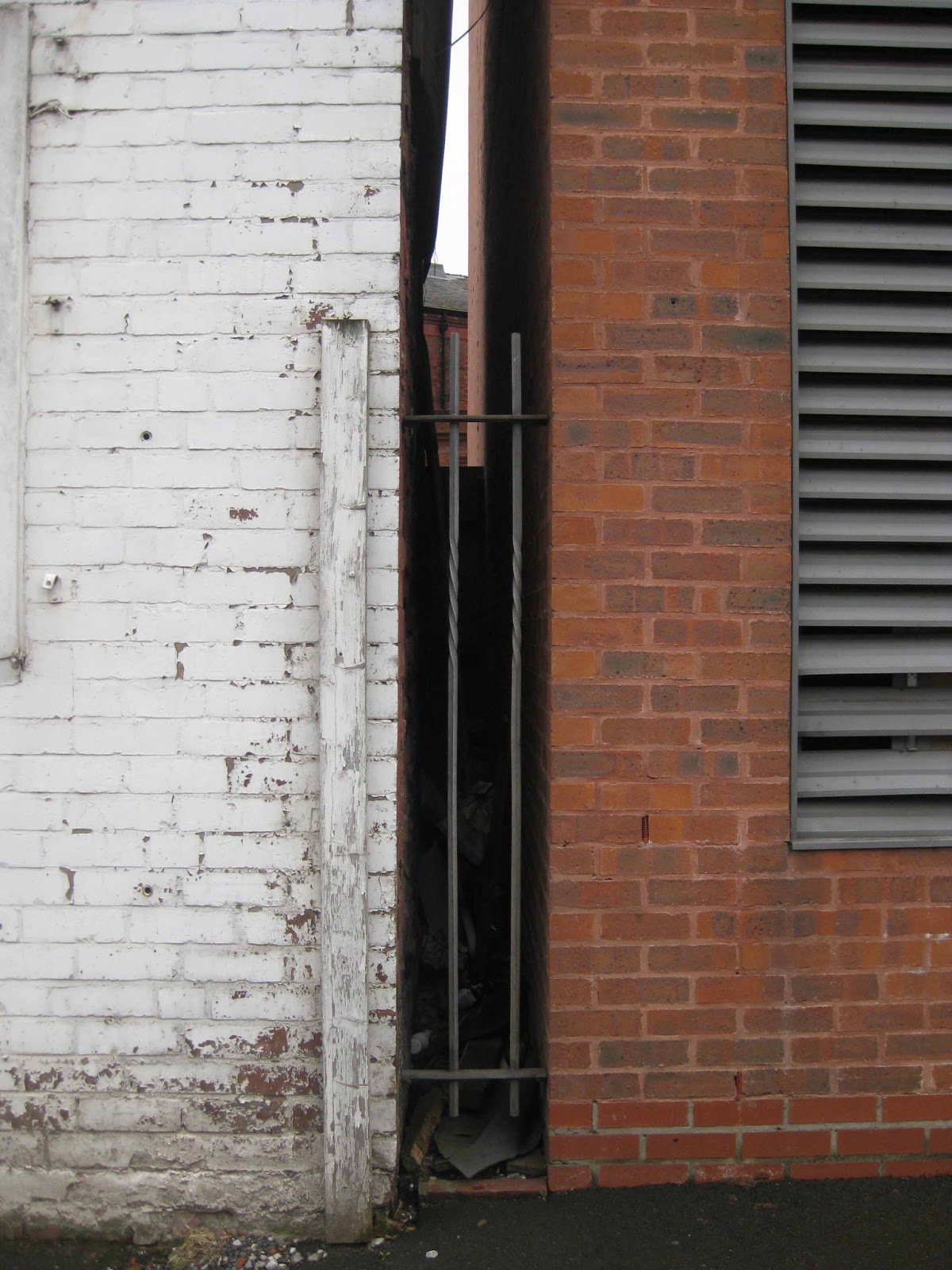
Paper and Mirabel studios (where paper is located) are new to the area, but since they opened, a sushi bar has opened around the corner...gentrification is already beginning. I am keen to pick up on the way that this works. The Mirabel building is just off Deansgate really, so why has it taken so long for development to begin. I want to express the way that an art space affects is locality. I suddenly realised while I was there that there is a real correlation between the way that invasive weeds like buddleia find thetiny gaps and bits of overlooked fertile ground and grow there, and that this is exactly what artists do too. We operate in the forgotten places, and demonstrate value, we make something out of nothing, and slowly views change of an area.
I began to think that for Paper: Perform, I should do something that leaks out of the gallery, into the nooks and crevices of the streets outside of paper, populating the gaps, and letting people know that paper is there.
I am thinking of making a kit, so that people can make their own paper buddleia, to put on the streets outside of the gallery. I am also thinking of a walk from Manchester Piccadilly to Paper, noticing all of the evidence of weeds on the way. I would like to do something involving an ikebana demonstration, but I am not sure how it fits with the other ideas. I have also found myself buying a load of wild flower cigarette cards since getting back from Manchester, not sure why, but I am sure it will all make sense by June.