 Thursday morning a group of artists. writers and other creative/cultural workers met at Stoke train station. The connection between us all being that we are going to be involved in GemmaThomas's SHOP project . This day was the official first day of the project, and Gemma had organised it as a site visit - the main idea being for everyone to meet, to see the SHOP but also to locate the project historically, socially and culturally within the Town. More about SHOP here.
 We set off from the station for a walk which took us under the Railway bridge - currently in real need of improvement. Considering the space as a possible pedestrian route into the town it is a sorry site. Kevin Bell, regeneration manager for the Town recognises this, and is looking into ways of improving the journey.
  We had a look around the grounds of Stoke Minster, before walking round to the back of the library and council offices.
 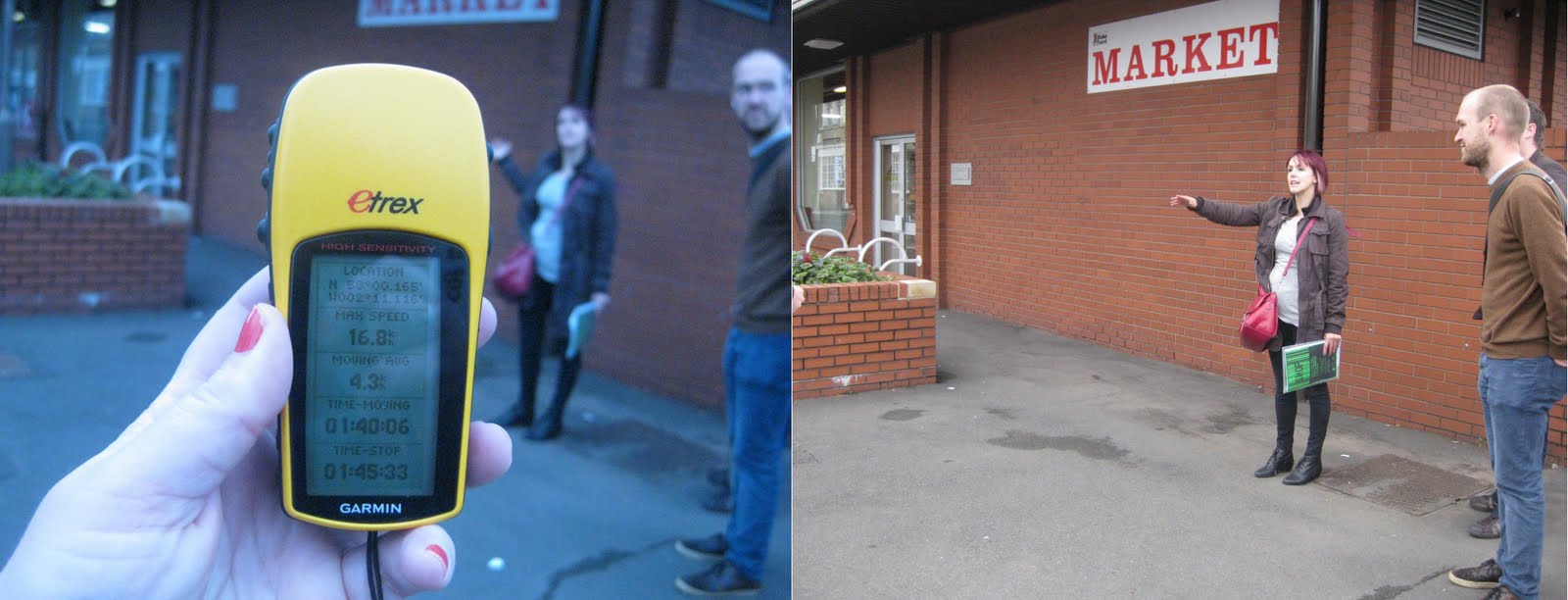 The indoor market is open days a week - it was a shame that it was closed on our site visit day. The market is next door to the new library/council office development. There is currently a competition which the public can vote on for a mural to be painted on the side of the market building.
 One of the things I am interested in exploring for my project with SHOP relates to the ethos of 'There is Beauty in the City' which asks people to look differently at spaces in the city, discovering hidden delights. When walking around Stoke with Gemma last week we had a good look at a lot of the architecture, and found the Sutherland Chambers building very beautiful, if neglected. It has six letter boxes, which act as 6 different views into the building.
 Here is the view through one of the right hand slots. The hall has beautiful majolica tiles.
 The Sutherland Chambers building is across the road from the shop, so we stopped off for a quick look and a much needed cuppa, before heading next door to Spode to meet up with Allen, the site manager, who had promised us a tour of the factory.
  This is my third visit to the factory since it has been closed, and it is truly amazing (and upsetting) to note how quickly the place is deteriorating.
  Allen does his best to keep the heart beating in the factory, but it is too big job, and a site like this needs people to keep it going.
  We talked about the different workers who had been here, some for their whole working lives, and one is even buried here.
 The factory is a beautiful and magical place, the mould rooms in particular are amazing, and represent years of the city's history.
 We then popped into the White Star for lunch.
 The White Star represents a rare success story in the Town's recent history. The pub opened a couple of years ago, and sells beer from local brewery 'Titanic'. The place is always busy when I go in, and offers a very nice pint , and a very reasonable lunch.
 Gemma had organised a buffet lunch for us - which was great except the vegetarian sandwiches, which seemed to be spring onion and butter!
  Apart from that the refuelling was great - before we headed back to the shop in order to do a Map of Independence.
 This activity involved each of the artists going out into the town to locate and Independent Shop, go inside and interview the shopkeeper in order to find out what they sell or do, what it is like running a business in Stoke, and ask if they would like to be kept informed about the SHOP project. They would leave an information sheet with the trader telling them about the project. Each artist would then photograph the shopkeeper holding something that represents their business and the shop frontage. Here I am explaining the activity.
Everyone then returned to the shop to add their research to the map and share the information gathered.
 This worked better than I could have hoped, as 12 shops were mapped from the activity, and we gained a really interesting insight into the sorts of businesses that are operating locally, and how people are feeling about operating in the Town. Out of the 12 shops which the artists approached 10 said they would like to be kept informed, one employee said it wasn't up to them, and one told us they would be closing down at the weekend.
 The activity has also made some real headway in letting people in the town know what is going on at SHOP - the next stage of Gemma's plans will be to invite the interested traders to an OPEN SHOP event, a tea and cake evening to discuss in further detail what it is like to run a business in the town - how SHOP can feed into that and build stronger connections. Through the Independence Mapping exercise we learned that some of the shops have already formed what they are calling a 'Coalition' to help support each other in the town - this is really interesting, and something that I feel we could really connect with.
  I think that the 'SHOP INDEPENDENT' branding which I have developed for my project could be used for this group of Shops - and perhaps my Regeneration Tour could look at celebrating Independence in the Town. I find this particularly interesting in the context of the 'Art in Empty Spaces' initiative.
  I feel it is really important that the artists operating in these deprived areas, taking over empty shops, are very sensitive to what is there already, and work with that. We will only be in these spaces for a short time, and it is important that we recognise this, and try to do something which could somehow improve the situation in some way. It may be an ambitious thought, but perhaps as a project working with the local shopkeepers, we could actually help to promote their businesses, get organised as a 'coalition' and create something lasting (a well branded network of support.) The next thing I will do is to collate the information gathered by the artists into a workable Map of Independence. I will be going along to the Trader's Open Shop events, and hopefully working with them to develop a tour, and a celebration of Independence in Stoke.
 Marc Wootton from the City's Cultural development team took part in the exercise, he went to the local sweet shop and got some bon bons.


